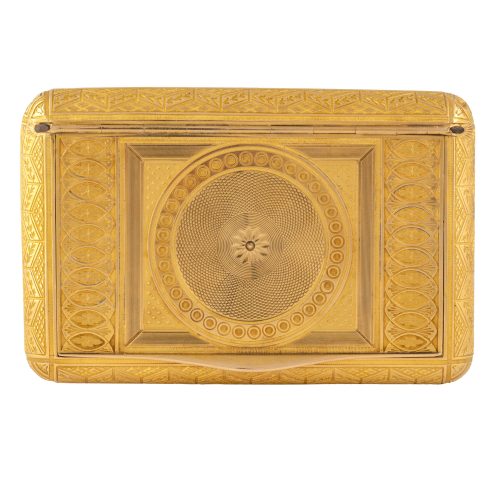
Russian Imperial-era Gold Snuff Box by Keibel, St. Petersburg, circa 1820
$8,500.00
This rare Russian gold snuff box was created during the period of Tsar Alexander I (1801-1825) by one of the most prominent Russian imperial goldsmiths working in the imperial capital of St. Petersburg, Johanne Wilhelm Keibel.
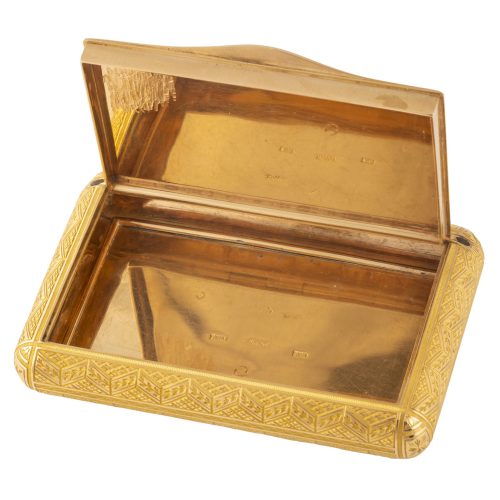
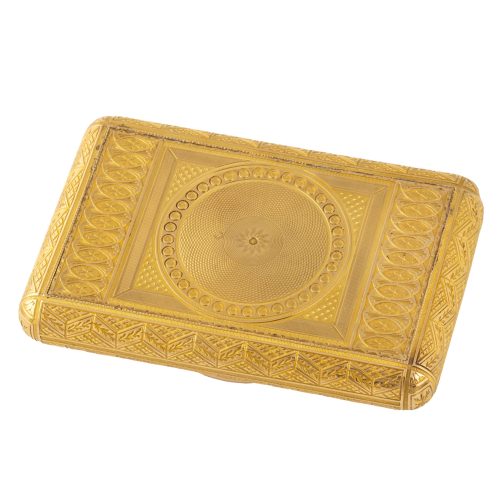
Rectangular with rounded corners, overall chased with foliate and geometric patterns, the hinged cover and base centering a roundel enclosing a star on a radiating engine-turned ground. Of matte and polished gold adding a beautiful contrast to the already rich gold patina.
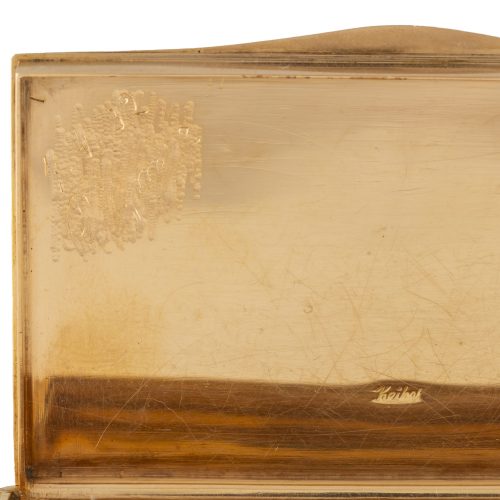
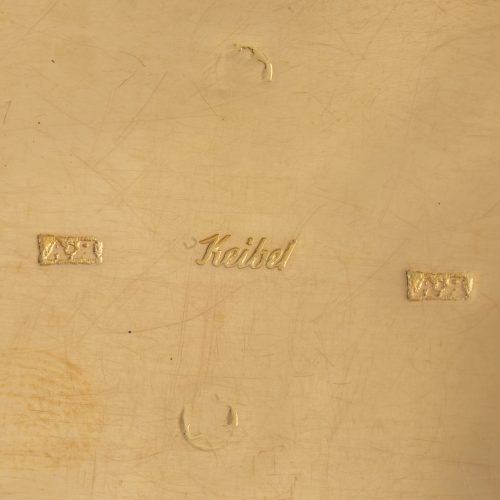
Signed Keibel in script with assaymaster’s Cyrillic initials A YA for Alexander Yashinov (active 1795-1826), crossed anchor and sceptre marks for St. Petersburg (worn) s
Approximately 100 grams or 3.21 troy ounces. 3 ½ x 2 3/8 x ½ in. (8.9 x 6 x 1.3 cm) (l x w x h).

— Keibel, Johann Wilhelm (1788–1862) —
Court jeweler to both Tsar Alexander I and Nicholas I and son of Russian imperial goldsmith Otto Keibel, Johann specialized in enamelware, court decorations, church plate and snuffboxes. Keibel restored the coronation crown of Tsar Nicholas I in 1826, became head of the foreign guild in 1828 and was court purveyor for the Chapter of Imperial and Royal Orders. Johann’s diamond creations won first prize along with Valliant in the All-Russian Exhibition of 1849 in St. Petersburg. He made numerous multirow diamond bracelets for Empress Alexandra Fedorovna which formed part of the crown jewels and most likely produced the lavish diamond rivière that Tsar Nicholas I gave her in 1843 to mark their 25th wedding anniversary and the birth of their children. Keibel also holds the distinction of having trained apprentice Gustav Fabergé (Carl’s father) in St. Petersburg, which led to the opening the famous Fabergé shop in 1842.
For more information on Keibel see, Beyond Fabergé: Imperial Russian Jewelry by Marie Betteley and David Schimmelpenninck van der Oye, Schiffer Publishing, 2020.
Out of stock