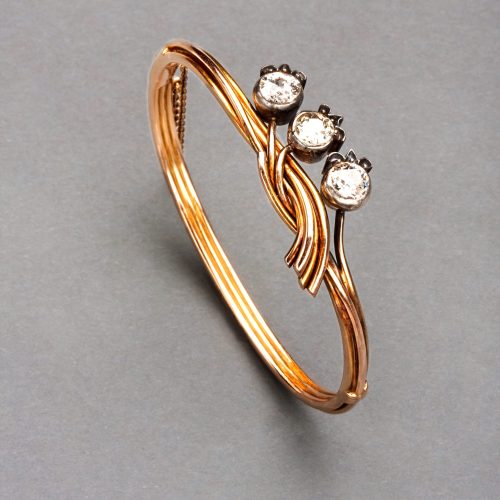
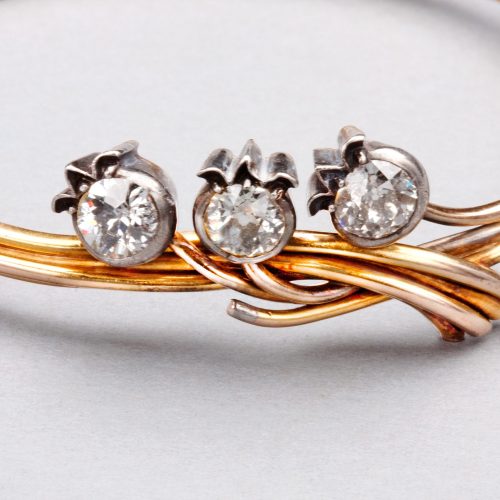
Of solid rose and yellow gold, the hinged bangle designed as tightly bundled stems of three lilies of the valley, the buds each set with an old-European cut diamond averaging approximately 1.06 carats (total carat weight of approximately 3.17), mounted in silver and gold.
Workmaster Knut Oscar Pihl, Moscow, circa 1890, marked on the bangle and on the clasp, O.P. with the Moscow town mark of St. George for circa 1890
interior dimension 2 ¼ by 2 in. (5.7 x 5 cm.); exterior: 2 ½ x 2 ¼ in. (6.4 x 5.7 cm.)
A photograph of a brooch of similar design is illustrated in the 1893 Fabergé Moscow catalogue, no. 65, page 13.
*SOLD*

SKU: B068


Knut Oskar Pihl (1860-1897)
Born in Pohja, Finland, Pihl moved to St. Petersburg at the age of six to work for his uncle, a clockmaker. He then became apprentice to Fabergé’s most renowned jewelry workmaster. August Holmström. In 1887 he married Fanny Holmström, August’s daughter. That same year, Carl Fabergé chose Pihl to head the newly opened jewelry workshop in Moscow, a position he held for ten years until his death at the age of 37. Due to his short life, few items by Oskar Pihl exist. Pihl’s daughter, Alma, extended the Fabergé tradition in the family. As a talented artist who worked for August Hollmström son, Albert, Alma created the designs for the Fabergé Winter Egg of 1913 and the Mosaic Egg of 1914.
Keep up with my latest art, treasure and jewelry finds, tours, and blog posts that take you all around the world and into the history of the most exquisite pieces and artisans when you join my list!
You can change your mind at any time by clicking the unsubscribe link in the footer of any email you receive from us, or by contacting us at marie@mariebetteley.com. We will treat your information with respect. For more information about our privacy practices please visit our website. By clicking below, you agree that we may process your information in accordance with these terms.