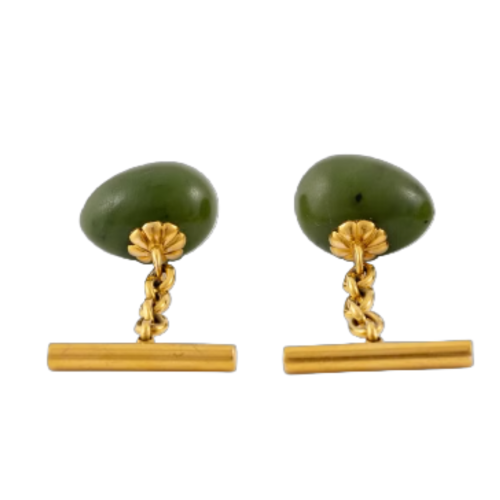
Pair of Russian Imperial-era Nephrite Gold Egg Cufflinks by Fabergé Workmaster Erik Kollin

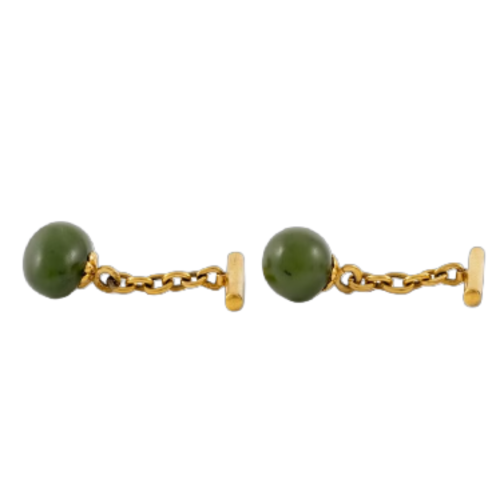
This pair of cufflinks was designed by Carl Fabergé’s first workmaster, Erik Kollin during the Romanov era in St. Petersburg, Russia. Each link terminates with a perfectly carved egg of nephrite, Fabergé’s favorite hardstone, and is fitted with a fluted gold cap which is attached to hand fashioned gold link chain ending in a cylindrical gold bar.

It was Kollin’s cicada gold cufflinks in the Etruscan style that first lured the Russian tsar Alexander III to Fabergé’s booth in Moscow’s Pan Russian Exhibition of 1882. Little did Carl Fabergé know that this inaugural purchase would unleash the series of imperial orders by the tsar and later his son Nicholas II for fifty fabled Fabergé Easter eggs and catapult the Russian goldsmith to international fame.

Fabergé had Erik Kollin to thank for breaking the ice with the Russian Tsar.

Egg-shaped cufflinks are very rare and Kollin seemed to be the only master jeweler in St. Petersburg to create them for the Imperial Russian goldsmith.

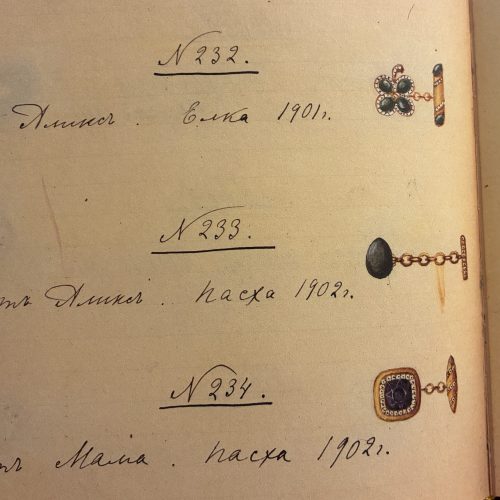
Empress Alexandra Feodovna gave her husband Tsar Nicholas II a pair of egg-shaped cufflinks by Kollin on Easter in 1902, which he rendered in gouache and described in his personal journal (image)  See The Jewel Album of Tsar Nicholas II, London, 1997, no. 233

For a pair of Fabergé bowenite egg cufflinks by Kollin sold here in 1991, see our blog.

Drag to view more product photos

Additional Product Details

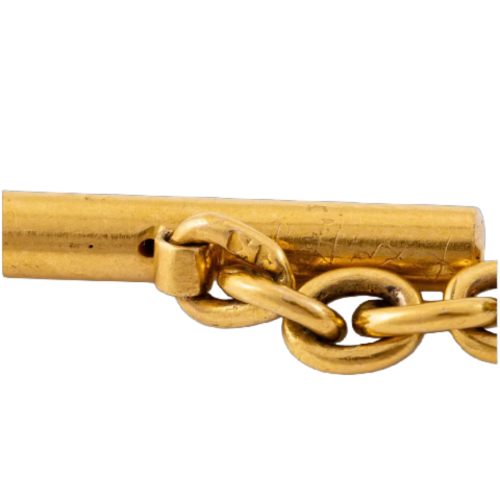
St. Petersburg, circa 1890 with maker’s initials EK marked in four places, with scratched illegible inventory number

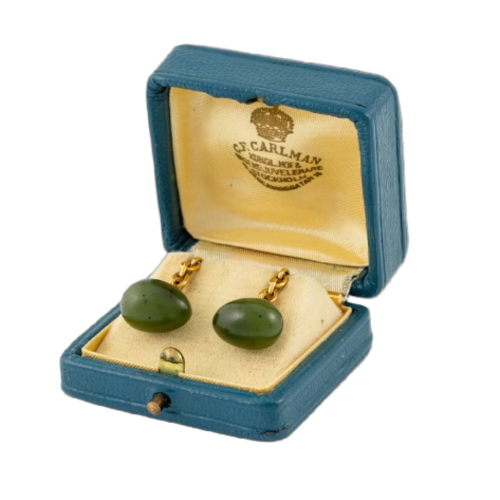
In a period blue leather gilded fitted box stamped with Swedish Crown Jeweler CF Carlman, Stockholm

Finnish-born Eric August Kollin (1836 to 1901) opened a jewelry workshop on Kazanskaya Street in St. Petersburg before joining the House of Fabergé in 1870 and becoming its first Chief Workmaster. Kollin was best known for his simplicity of design and gold workmanship in the revivalist style. His most famous creations were gold replicas of Scythian treasures following the sensational discovery of ancient gold jewels in 1867 in the Kerch peninsula east of Crimea.

This is my second purchase from the seller and, again, I can say it was a marvelous experience. The seller is highly knowledgeable, carries quality items, and is very willing to share her knowledge about the item you buy and also generalities about the times items are from. A very satisfying experience for me and highly recommended.

Get Marie Betteley's
Much-Loved eNewsletter!

Keep up with my latest art, treasure and jewelry finds, tours, and blog posts that take you all around the world and into the history of the most exquisite pieces and artisans when you join my list!

You can change your mind at any time by clicking the unsubscribe link in the footer of any email you receive from us, or by contacting us at marie@mariebetteley.com. We will treat your information with respect. For more information about our privacy practices please visit our website. By clicking below, you agree that we may process your information in accordance with these terms.